
Action is owned by the British investment fund 3i Group, listed on the London Stock Exchange. This capital structure radically distinguishes the brand from its French discount competitors, most of which belong to family groups or cooperatives. All Action stores in France operate as direct branches, without franchises or local partners.
Capital Structure of Action: the Role of 3i Group
3i Group acquired a majority stake in Action several years ago and then strengthened its holding through internal restructurings. Since 2024, the fund has consolidated its position without capital dilution, putting an end to recurring speculations about a possible divestiture or IPO of Action.
The operational headquarters of Action remains in Zwaagdijk-Oost, Netherlands, where the brand was founded in 1993. Strategic decisions (pricing policy, product selection, geographical placement) are made from this Dutch center. The French subsidiary has no decision-making autonomy over the assortment or prices.
To better understand who is the owner of the Action brand in France, one must trace this chain of control: 3i Group owns Action Holding, which oversees all national subsidiaries, including Action France SAS.
A European directive transposed into French law in March 2025 now imposes a strengthened declaration of beneficial owners for subsidiaries of non-EU funds. This obligation directly concerns Action France and increases transparency regarding the identity of capital control, without altering operational governance.

Action’s 100% Branch Model and CSR Limits in France
Action does not franchise. Each store in France is a branch managed directly by the national subsidiary. This model ensures total uniformity: same prices, same assortment, same working conditions from one outlet to another.
This centralization has a downside. Branches have no local adaptation margin regarding social responsibility issues. A store located in a metropolis committed to zero waste strictly applies the same processes as a store in a rural area, with no leeway to adjust the offering or establish partnerships with local actors.
“Zero Premium” Strategy and Eco-Responsible Vulnerability
Action maintains an inflexible pricing policy, with no organic segment or premium range. This approach gives it a stock turnover rate significantly faster than competitors like Lidl, which has diversified its offering towards organic since 2025.
The risk is identifiable: French consumer expectations regarding eco-responsible products are increasing. By remaining locked into an assortment managed from the Netherlands, Action exposes itself to a growing disconnect with local demand in sustainable segments.
- No listing of organic or labeled products in the standard Action assortment
- No locally adapted sourcing policy by country, unlike German food discounters
- Absence of specific CSR reporting for the French subsidiary, with data consolidated at the Dutch group level
Social Conflicts in Action France Branch
Since late 2024, Action France has faced a significant increase in social conflicts in its stores. Employees report increased pressure on work rates, linked to the rapid product turnover model and the sustained opening of new outlets.
The branch status complicates collective bargaining. French union representatives must deal with management whose budgetary decisions are made in the Netherlands. Employee representatives have no direct leverage over the group’s social policy, which prolongs conflict resolution times.
Operational Consequences on the Ground
Turnover in Action stores in France remains a point of tension. The combination of low prices, high work rates, and reduced supervision per store creates working conditions that several employee reports describe as difficult. This point distinguishes Action from French food discount brands, where national collective agreements provide a more structured framework.
Action’s Expansion in France: Pace and Location
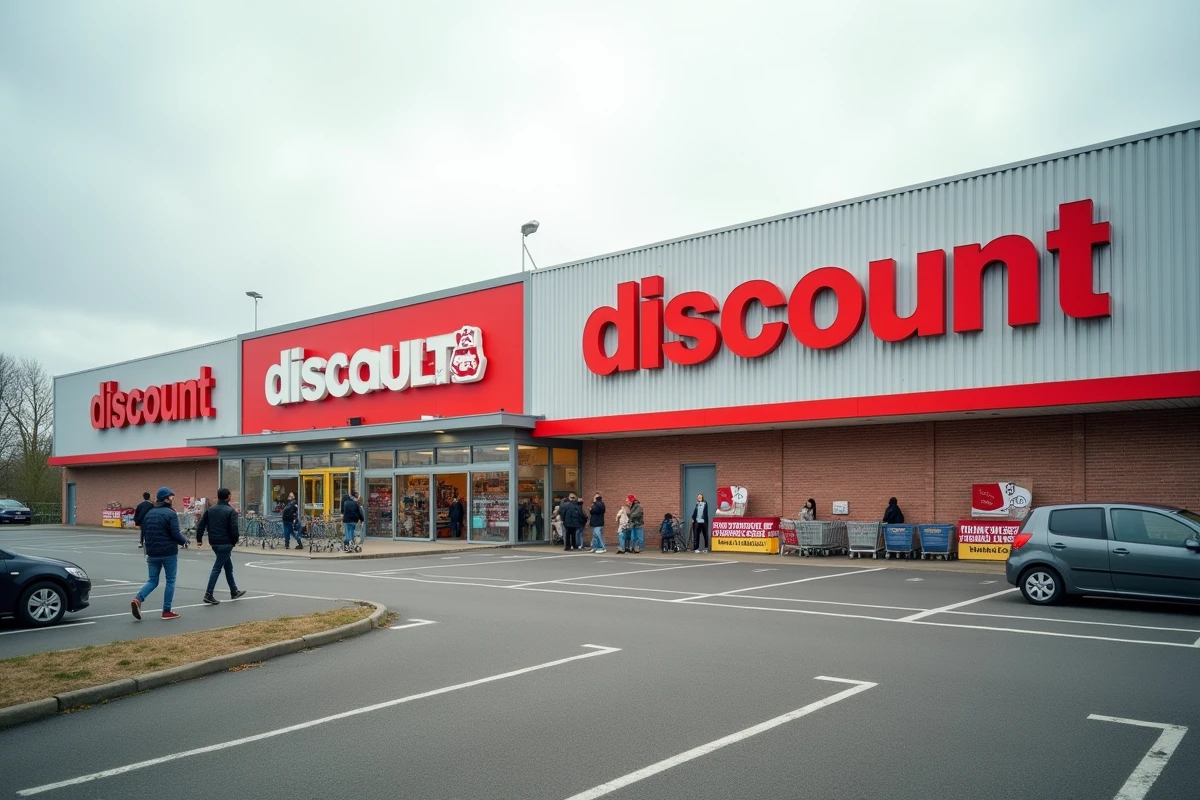
Action arrived in France in 2012. Since then, the brand has exceeded the initial expectations of its shareholder, with a territorial network that now covers the majority of French regions. Store openings are concentrated in peripheral commercial areas, where rents remain compatible with the low-price model.
The choice of locations is managed from the Netherlands, with a dedicated real estate team for France. This centralized operation allows for rapid execution: an identified site can host a store within a few months, thanks to a standardized distribution concept that does not require local architectural adaptation.
- Almost exclusively located in city peripheries, in retail parks or existing commercial areas
- Standardized sales area for each store, facilitating the replication of the concept
- Identical assortment across the entire territory, with product rotations managed by the Dutch headquarters
Action’s model relies on a clear trade-off: maximum uniformity against minimal local flexibility. This strategic choice, dictated by 3i Group and the Dutch management, explains both the rapid expansion of the brand in France and the tensions that emerge in social and environmental fields. The question of adapting to the specifics of the French market remains open, as long as decisions continue to be made exclusively from Zwaagdijk-Oost.