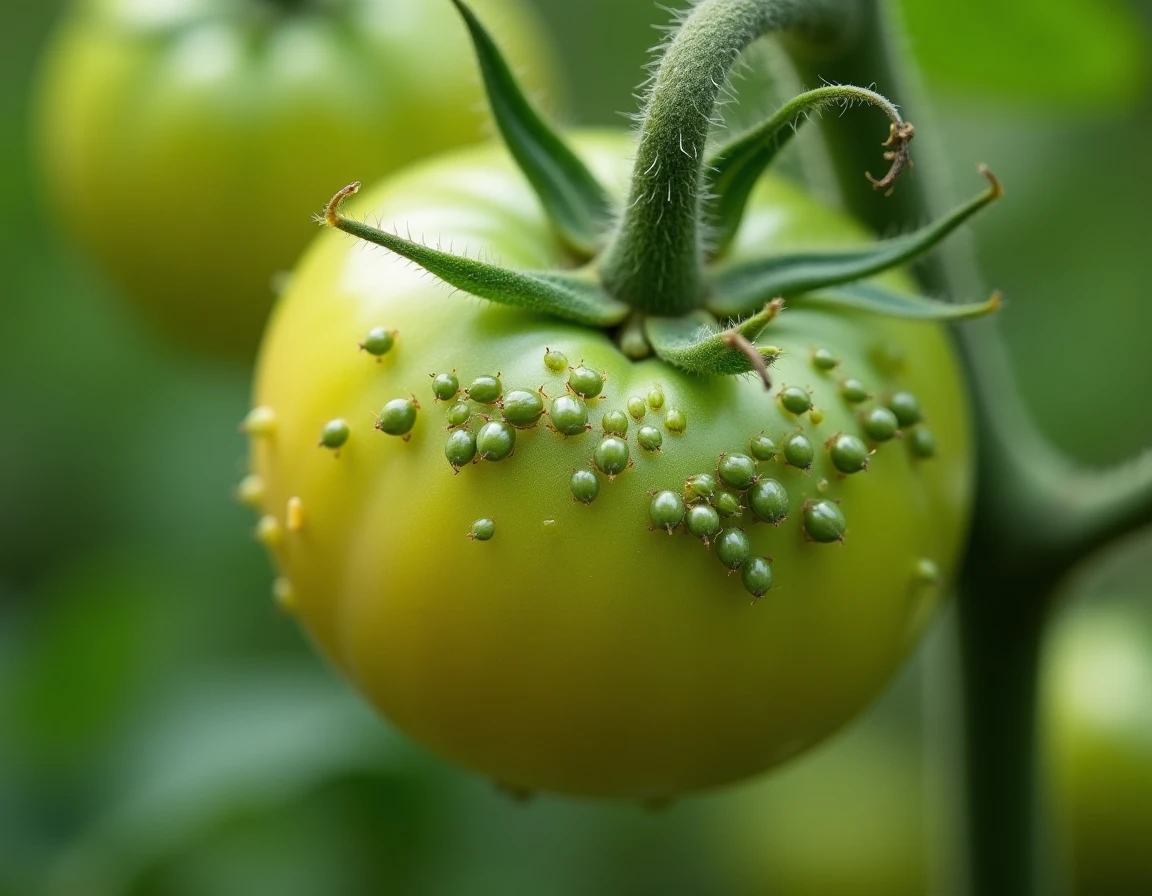
Chewed leaves, punctured fruits, a greenish colony settling on the stems: tomato pests don’t give any warning. Quickly identifying harmful insects for tomatoes allows for intervention before the damage compromises the harvest. However, it’s essential to distinguish the true culprits from mere visitors and to choose methods that do not destroy the allies of the garden.
Stink bugs on tomatoes: damage often confused with a disease

Aphids and whiteflies monopolize gardeners’ attention. Stink bugs, on the other hand, go under the radar. Their sting, however, leaves a characteristic mark on the fruit: a discolored area, slightly spongy under the skin, sometimes surrounded by a whitish halo.
Have you ever found a tomato that looked normal on the outside but had a corky flesh when cut? This is typically damage from a stink bug. The fruit remains edible if the affected area is small: just cut it away with a knife. A tomato punctured by a stink bug is not rotten, it is simply locally damaged.
The confusion with blight or blossom end rot is common. The difference: the stink bug creates punctate lesions, scattered on the fruit, without the gradual darkening of blight or the apical necrosis of blossom end rot. Observing the external side of the fruit in the light helps to spot the sting marks. To better understand the harmful insects for tomatoes, a precise identification of each pest remains essential.
Why some grandmother’s tips work in the garden
Planting basil at the foot of tomatoes, installing marigolds along the edges, spraying a garlic decoction: these inherited practices work, but not for the reasons often imagined.
Companion plants and olfactory confusion
Marigolds do not “repel” insects in the strict sense. Their strong odor partially masks the chemical signals emitted by the tomato. Pests locate their hosts by smell much more than by sight. By muddling this signal, companion plants reduce the number of insects that settle on the right plant.
Basil acts similarly. It emits volatile compounds (linalool, eugenol) that disrupt the location of the tomato by whiteflies and certain aphids. The effect is real, but it diminishes as you move away from the basil plant. Planting a single pot for ten tomato plants is not enough.
Decoctions: a limited but measurable effect
Nettle manure or garlic decoction do not kill insects. They strengthen the leaf cuticle or create a temporary repellent film. The effectiveness depends on the regularity of applications. A spray every ten days is a minimum to maintain the effect.
These methods work better as prevention than as a cure. In the face of an already established infestation, they slow down the progression without stopping it.
Releasing beneficials in the garden: an active protection against tomato pests
Attracting ladybugs is good. Intentionally introducing targeted beneficials into the garden is a more reliable approach. This technique, common in professional greenhouses, can also be adapted to private gardens.
- Chrysop larvae devour aphids at a steady pace. They can be purchased as eggs or larvae to be placed directly on the infested plants. They mainly act at night.
- Parasitoid wasps (genus Encarsia or Macrolophus) lay their eggs in whitefly larvae. They do not sting humans and are tiny. Their effectiveness against whiteflies in greenhouses is well documented.
- Adult hoverflies resemble small striped wasps. Their larvae consume aphids in large quantities. To attract them, simple flowers (like phacelia, yarrow) near the garden are sufficient.
The classic mistake: releasing beneficials while spraying an insecticide, even “natural.” Pyrethrum, for example, kills both pests and ladybugs, chrysop larvae, and hoverflies. A non-selective insecticide treatment cancels the effect of releasing beneficials.
Protecting tomatoes without harming pollinators: methods to sort
Have you noticed that your tomatoes produce more fruit when bumblebees visit the garden? The tomato, even though it self-pollinates, benefits from the vibrations of pollinators’ wings to release its pollen. Any pest control method that drives away or kills pollinators directly reduces the harvest.
Methods compatible with pollinators
- Fine mesh insect nets protect against whiteflies and small moths, but also block pollinators. Solution: remove the net for a few hours in the morning when bumblebees are active and pests are less mobile.
- Diluted black soap (at low concentration) acts by contact on aphids and whiteflies. It leaves no toxic residue once dry. Spraying in the evening limits bee exposure.
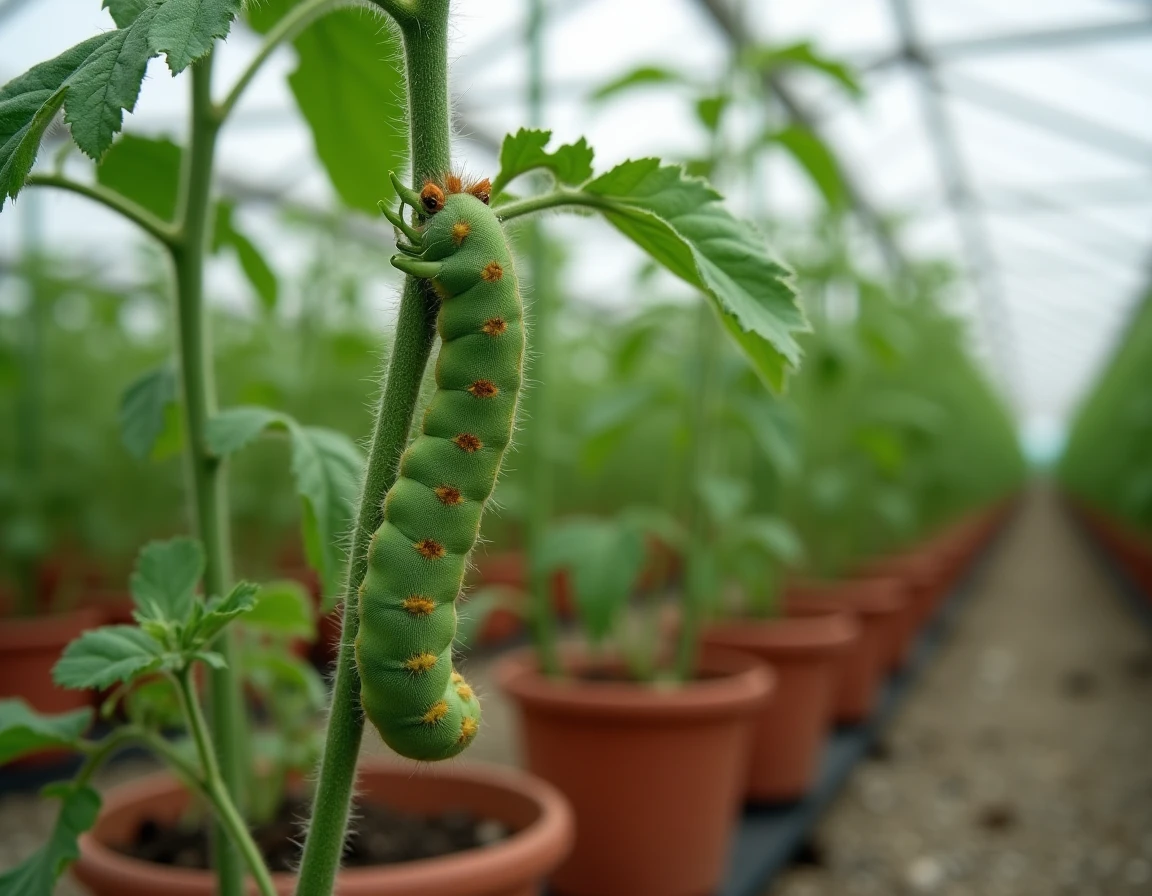
- Bacillus thuringiensis (Bt) targets caterpillars without affecting non-target insects. It is useful against the tomato hornworm, a moth whose larvae burrow into the fruits.
Methods to avoid or regulate
Natural pyrethrum, often presented as “organic,” is a broad-spectrum insecticide. It destroys populations of beneficials and pollinators just like pests. Its use is justified only as a last resort, in a limited area, and never during full bloom.
Yellow sticky chromatic traps capture whiteflies, but also useful micro-hymenopterans. Placing them under the foliage, out of the flight paths of pollinators, reduces this collateral risk.
Protecting tomatoes from harmful insects becomes more effective when it combines several low-impact approaches. Combining companion plants for olfactory confusion, introducing beneficials for biological control, and reserving contact treatments for critical situations yields better results than a single product applied routinely. Sorting between compatible methods and destructive methods for beneficial fauna remains the most cost-effective gesture in the garden.