
The language of seasonal fashion trends masks a deeper shift in everyday wardrobes. Since 2025, Google Trends searches related to clothing repair and care have been steadily rising, according to tracking published by Circular Fashion News in its H1/2026 report. Expressing your style now depends just as much on choosing a cut or color as on being able to make your clothes last, fit better and feel more personal.
Decorative mending and sashiko: the fashion trend you won’t see on the runway
Circular Fashion News’ State of Clothing Repair & Care H1/2026 documents a clear shift: visible mending is becoming an aesthetic choice, not just a practical fix. Mending jeans with sashiko stitching or adding a contrasting patch to a wool coat turns a textile mishap into a signature detail.
Pinterest’s Hobbies Trend Report 2026 confirms the trend, recording a marked rise in searches for sashiko and the aesthetics of repair. On Le Temps qu’il Faut’s fashion section, this approach translates into curated selections of pieces designed to last and lend themselves to personalization.
The H1/2026 report does, however, temper the enthusiasm: the cost of repairs remains a real barrier, and the investment only pays off for pieces whose construction quality justifies it. A wool-fabric blazer is worth carefully mending. A low-quality jersey T-shirt, rarely.
How to tell whether a piece is worth repairing
- Fabric density and the strength of the original seams: a sufficiently dense fabric and neat topstitching indicate a sound basis for repairs.
- The cost of replacing it with a piece of equivalent quality: if a new item costs three to four times as much as the alteration, repairing it is still worthwhile.
- Its place in your personal style: a piece that anchors your wardrobe (a trench coat, raw denim jeans or a work jacket) merits regular care more than an impulse buy worn for two seasons.

Everyday wardrobe: choose cuts and colors that work across seasons
Relaxed cuts (barrel-leg trousers, oversized shirts) have dominated fall and winter wardrobes for several seasons. Their staying power comes with a practical advantage: a looser fit is easier to alter and adjust than a close-fitting cut.
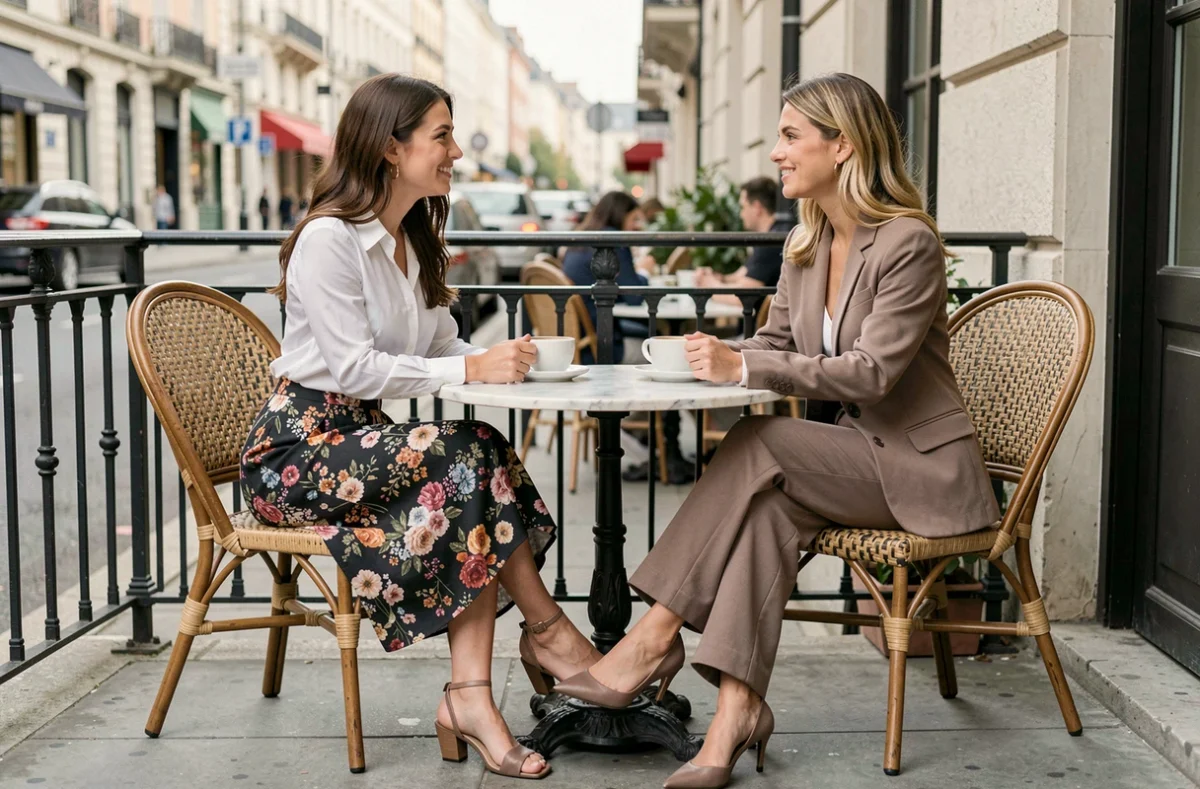
When it comes to color, monochrome is still the most reliable way to put together a cohesive look with minimal effort. A tonal outfit in brown, gray or navy works from the office to an evening out. Bright colors (red, forest green, mustard yellow) are best used as accents on an accessory or a single piece—not in a head-to-toe look unless you know exactly what you’re doing.
Trousers, jackets and knitwear: the pieces to build your style around
A well-cut pair of trousers in heavyweight cotton or raw denim is a wardrobe staple. The cut (straight, slightly flared or barrel-leg) should suit your body shape, not the latest trend. We find that the most cohesive wardrobes are built around three or four interchangeable bottoms, not ten.
A structured jacket (a blazer, flannel overshirt or heavyweight cotton work jacket) can replace a coat whenever the weather allows. It gives any basic outfit a sense of purpose.
Knitwear (a crew-neck sweater or button-front cardigan) completes the look. Choosing natural fibers (merino wool, combed cotton or recycled cashmere) helps garments age better and makes them easier to care for over time.
Textile responsibility in Europe: what the new rules mean for consumers
Since January 2025, European Union countries have been required to collect textiles separately for reuse or recycling. New European rules also provide for extended producer responsibility schemes, according to the European Week for Waste Reduction.
For consumers, this regulatory shift has a direct consequence: brands that invest in product durability (reinforced seams, certified fabrics and available replacement parts) will stand apart from those that externalize their environmental costs. Reading fabric labels and checking whether a brand offers alterations or take-back services are becoming habits of style as much as ethics.
Retailers and repair services: a practical factor to consider
Mainstream retailers are beginning to offer in-house repair services. They’re no longer the preserve of luxury fashion houses. Having a much-loved piece altered or repaired instead of replacing it is becoming an accessible option, provided you know where to find reliable alteration services in your neighborhood or through programs offered by certain brands.
Personalize instead of accumulating: the real key to everyday style
Accumulating trendy pieces makes for a disjointed wardrobe. By contrast, a smaller number of carefully chosen, well-maintained and, if needed, altered garments (a tailored hem, replacement buttons or natural dye on faded cotton) creates an instantly cohesive look.
Personalization doesn’t require a tailor’s expertise. Replace a coat’s buttons, shorten a pair of trousers by two centimeters or add an embroidered patch to a denim jacket: these small alterations cost little and can completely change how a piece looks.
- Replacing a blazer’s original buttons with horn or antiqued metal ones changes its feel (casual, dressy or workwear).
- Dyeing a yellowed white T-shirt with plant-based dye gives it a new lease on life in a different color.
- Adding leather elbow patches to a wool sweater reinforces a high-wear area while adding a distinctive detail.
Everyday style is built less through addition than through attention to detail. A streamlined wardrobe of pieces whose fit, fabric and limitations you know offers more winning combinations than a closet packed with fleeting trends. The most elegant garment is the one you wear long enough to make it your own.