
Pain in the upper left abdomen, beneath the ribs, can involve two nearby but distinct organs: the stomach and the tail of the pancreas. Their anatomical proximity explains why the sensations can feel similar. The distinction depends on the type of pain, how it relates to meals, and any accompanying symptoms.
Left upper quadrant anatomy: the stomach and pancreas side by side
The left upper quadrant is the area beneath the left costal margin. The stomach occupies most of it: its greater curvature extends down toward the left flank, while the fundus rises up against the diaphragm.
The pancreas, by contrast, is a retroperitoneal organ (located behind the abdominal cavity). Its terminal portion, called the tail of the pancreas, lies just behind the stomach, next to the spleen. This deep position has a direct consequence: pain in the upper left abdomen originating in the pancreas often radiates to the back, whereas stomach pain tends to remain closer to the surface, toward the front.
Understanding this anatomical overlap can help you interpret the characteristics of the pain, since the distinction often comes down to the details of the symptoms.
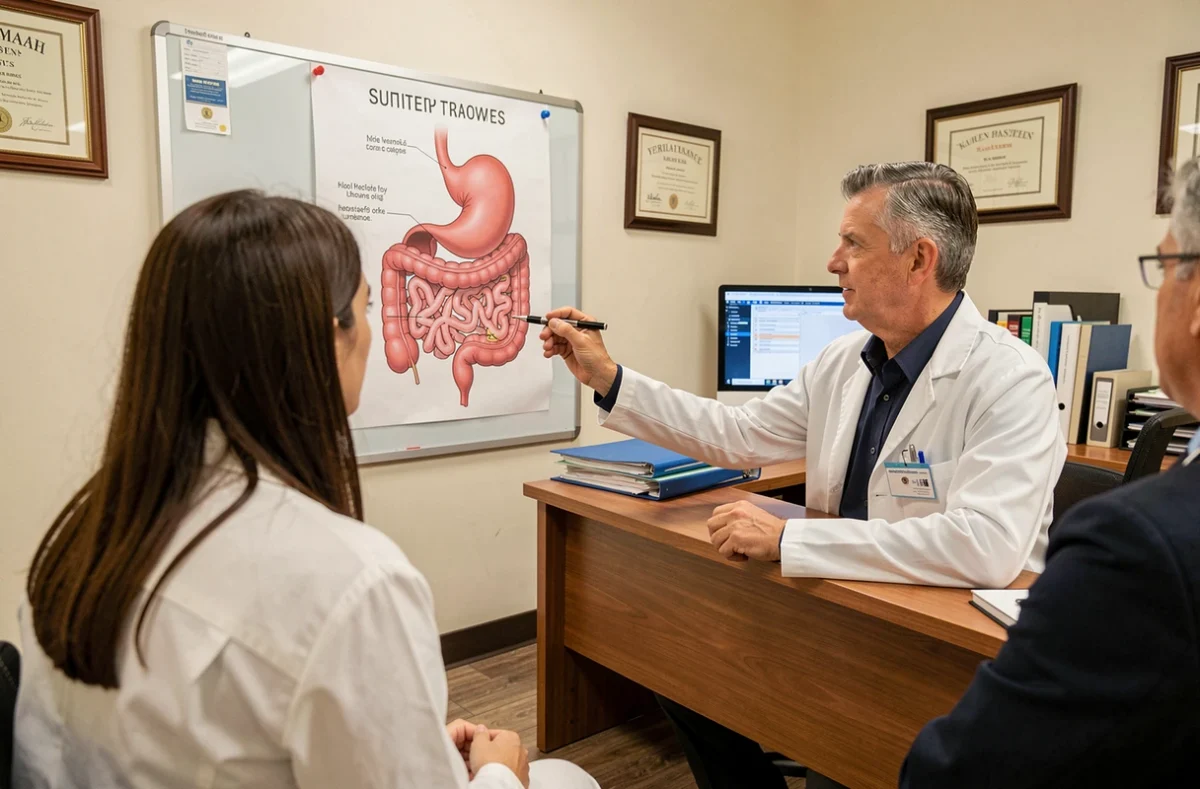
Stomach pain: burning, cramps, and a direct link to meals
Stomach pain most often takes the form of epigastric burning or cramps. It is felt in the pit of the stomach, sometimes slightly to the left, and remains localized at the front without radiating through to the back.
Its most recognizable feature is its close relationship with food. Depending on the underlying condition, this relationship can take different forms:
- Gastritis causes burning pain during or just after a meal, often made worse by acidic or spicy foods or alcohol.
- A gastric ulcer causes pain that follows a pattern linked to meals. Eating may temporarily ease it, but the pain can return a few hours later.
- Gastroesophageal reflux causes a rising sensation behind the breastbone, which worsens when lying down or bending forward.
An antacid or proton pump inhibitor generally relieves this type of stomach pain within a few days. If an antacid noticeably eases the pain, a stomach-related cause is likely. This response to treatment is also a clinical clue doctors use during an initial assessment.
Pancreatic pain: sudden, severe, and radiating to the back
Pain related to the pancreas has a very different pattern. In acute pancreatitis, it comes on suddenly, quickly becomes severe, and is characterized by pain that pierces through to the back, as if it were passing straight through the abdomen.
This pain does not respond to antacids. It worsens when lying flat on the back and eases somewhat when the person leans forward or curls up in the fetal position. This relief from changing position is a commonly observed distinguishing sign.
Symptoms associated with acute pancreatitis
Pancreatic pain is often accompanied by persistent vomiting that does not relieve the pain, unlike stomach-related nausea, which sometimes eases after vomiting. A mild fever, a rapid pulse, and widespread abdominal tenderness may also occur.
The main causes of acute pancreatitis are gallstones and heavy alcohol consumption. Even when the pain is felt on the left, doctors will check for gallstones as part of the assessment, since a migrating stone can block the pancreatic duct and trigger inflammation.
Diagnostic criteria: why pain alone is not enough
The American College of Gastroenterology guidelines published in 2024 state that a diagnosis of acute pancreatitis requires at least two of three criteria: compatible abdominal pain, pancreatic enzyme levels more than three times the upper limit of normal (lipase or amylase), and suggestive imaging findings.
An elevated lipase level alone does not confirm pancreatitis. A CT scan is also not always needed at the outset: the 2024 ACG guidelines reserve computed tomography for cases where the diagnosis remains uncertain or the patient’s condition does not improve after 48 to 72 hours.
For stomach conditions, diagnosis relies more on an upper gastrointestinal endoscopy (gastroscopy), which allows doctors to examine the stomach lining directly and test for Helicobacter pylori infection using a biopsy.
Comparison table: stomach or pancreas?
| Characteristic | Stomach pain | Pancreatic pain |
|---|---|---|
| Type of pain | Burning, cramping | Severe, deep pain |
| Radiation | Remains at the front; may rise into the chest | Radiates through to the back |
| Link to meals | Worsened or relieved by eating | Little affected by meals |
| Effect of antacids | Often provides relief | No effect |
| Position that brings relief | Sitting semi-upright (reflux) | Leaning forward or curling up in the fetal position |
| Key test | Gastroscopy | Blood lipase test; CT scan if the diagnosis is uncertain |
Emergency warning signs: when to call 15
Some symptoms require an immediate call to the SAMU emergency medical service. Vomiting blood, black stools, or sudden pain that pierces through to the back and is accompanied by feeling faint may indicate gastrointestinal bleeding or severe pancreatitis with vascular complications.
Shortness of breath combined with epigastric pain radiating to the left arm may point to a heart problem, which must be ruled out first, particularly in people over 50 or those with cardiovascular risk factors.
Even when there are no emergency symptoms, pain that lasts more than a few days, wakes you at night, or is accompanied by unexplained weight loss warrants prompt medical attention. The doctor will decide which tests are appropriate based on the pain pattern, medical history, and initial lab results; there is no need to order multiple imaging tests right away.