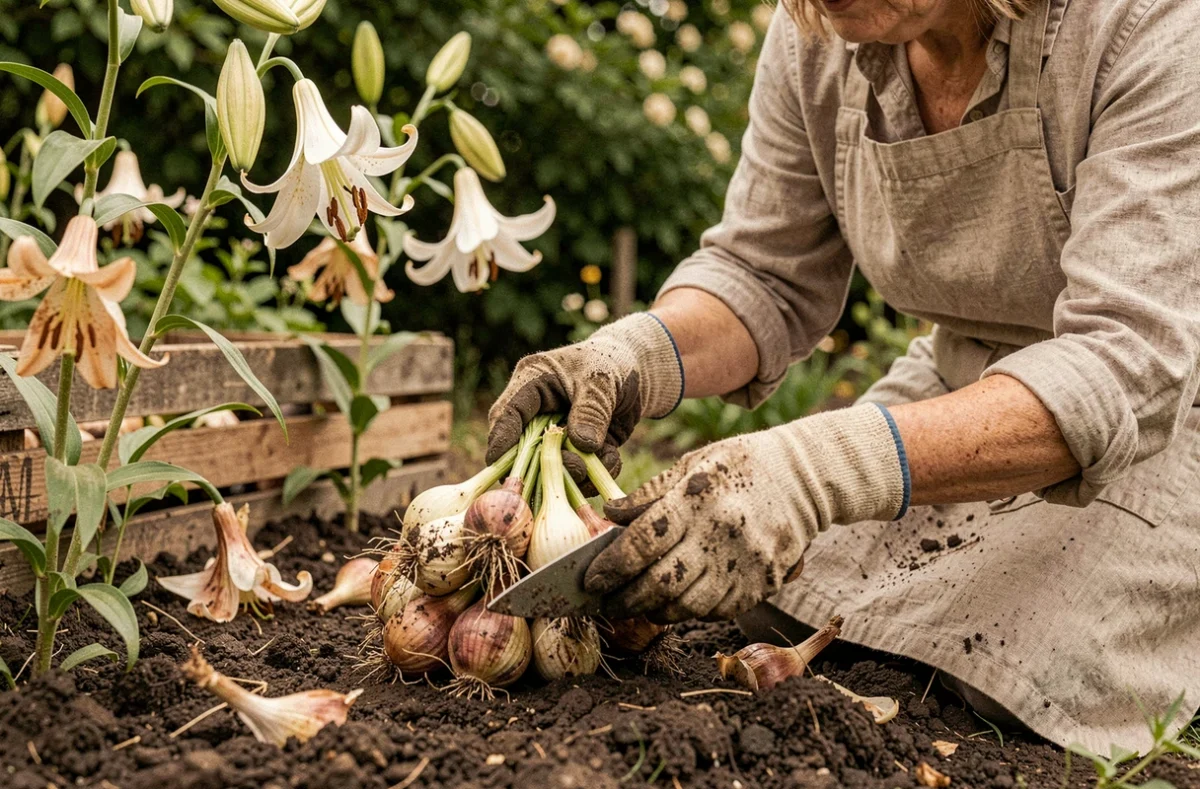
A mass of lilies that has finished blooming in July poses a concrete question: should the bulbs be removed from the ground or left undisturbed? The answer is different for clay soil that retains water compared to well-drained sandy ground.
The reflex to systematically dig up lily bulbs after flowering comes from a time when all bulbs were treated the same way. Most hardy lilies do not need this intervention.
Soil drainage: the real criterion for digging up lily bulbs or not
It is often said that bulbs should be uprooted every autumn. In fact, the Royal Horticultural Society recommends planting lilies as hardy bulbs and leaving them in place. Digging up becomes relevant when flowering declines, when the soil drains poorly, or when one wants to move a clump.
The number one problem with lily bulbs left in the ground is standing water. Compact or clay soil that remains saturated with moisture in winter causes the scales of the bulb to rot. Improving drainage often prevents the need to dig up: adding gravel or coarse sand at the bottom of the planting hole is sufficient in many situations.
Before grabbing the spade, one can check the condition of the soil by pushing a finger about ten centimeters deep a few days after rain. If the soil sticks and remains saturated, the risk to the bulbs is real. If it crumbles, the lilies can be left in place without hesitation. Several gardeners share this approach in garden articles on L’Atelier du Bricolage, with concrete feedback depending on soil types.
Potted lily bulbs: a case where digging up makes a difference
Lilies grown in pots follow a different logic. The volume of substrate is limited, nutrients deplete quickly, and frost can penetrate the walls of the container much more easily than it does in the ground.
After flowering, placing the pot outside in a sheltered location remains the first thing to do. Watering is gradually reduced when the foliage begins to yellow, without allowing the substrate to dry out completely during winter. The bulb remains alive even without visible aerial parts.
Two options then present themselves:
- Leave the bulb in its pot, protecting it from frost with a winter cover or bringing it into a cool, bright location.
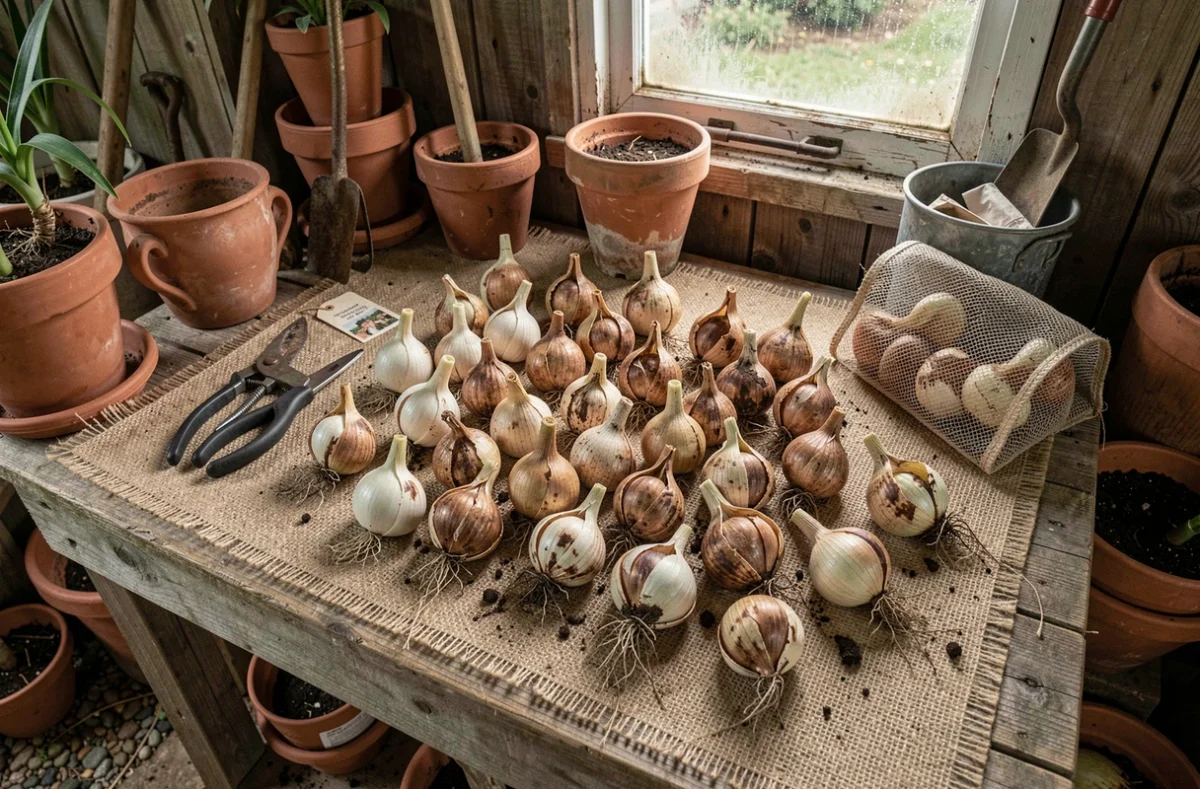
- Dig up the bulb in autumn, clean it, check that it is neither soft nor spotted, and then replant it in fresh substrate the following spring.
- Take advantage of repotting to separate the bulbils that have formed around the mother bulb, allowing for plant multiplication.
In pots, digging up mainly serves to check the health of the bulb and to renew depleted substrate. It is not an annual obligation, but it is a good practice every two to three years.
Lily foliage after flowering: when to cut without compromising the bulb
We all want to tidy up the stems once the flowers have faded. The trap is cutting too early. The still-green foliage continues to photosynthesize and feeds the bulb with reserves for the following year. Removing the green leaves amounts to starving the bulb.
The right method: cut the faded flowers as soon as they wilt, leaving the stem and leaves intact. Wait for the foliage to naturally yellow and dry before cutting the stem down to the ground. Depending on the varieties and the climate, this process takes several weeks after flowering ends.
Fertilizer after lily flowering
Applying a potassium-rich fertilizer just after flowering helps the bulb to replenish its reserves. Excess nitrogen should be avoided at this stage, as it would promote leaf growth at the expense of storage in the bulb. A moderately dosed fertilizer for flowering plants will do the trick.
Concrete signs that a lily bulb needs to be dug up
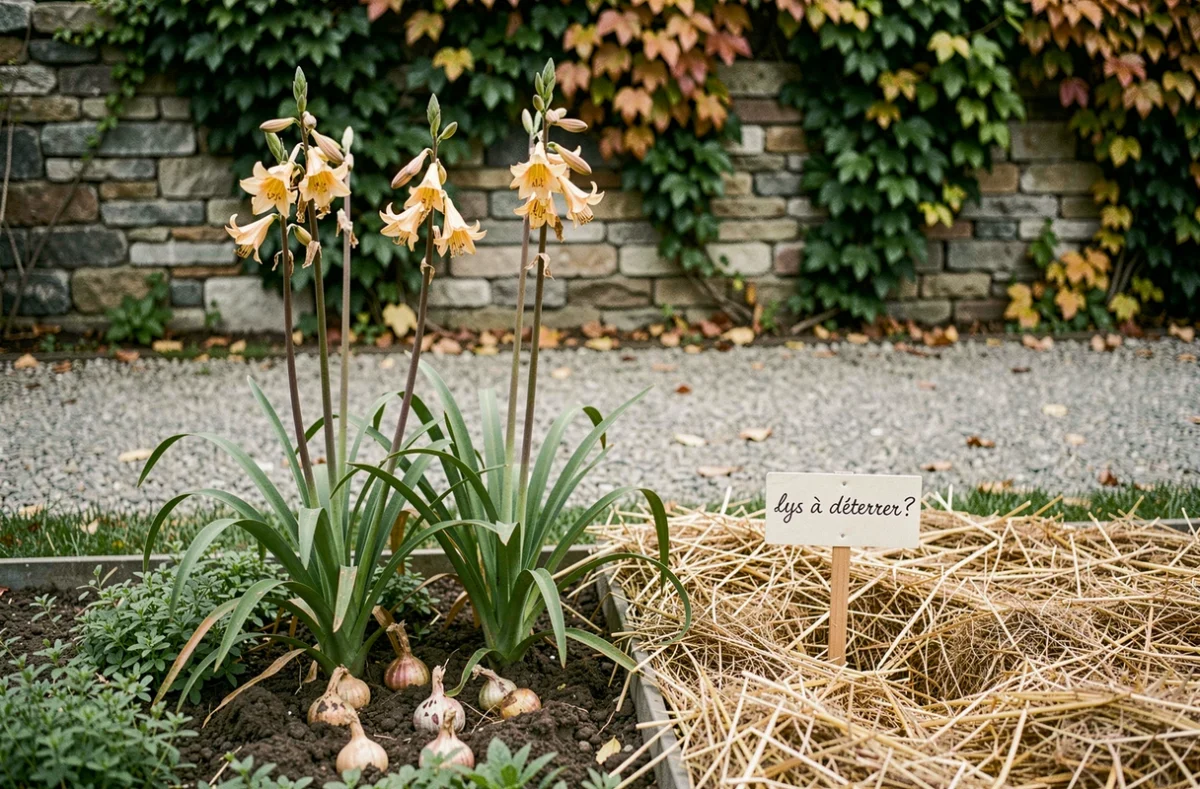
Rather than following a rigid schedule, it is better to observe the plant. Some signals clearly indicate that the bulb needs to be removed from the ground.
- Flowering decreases year after year while the location receives enough sunlight: the bulb may be too cramped or exhausted.
- Brown spots or soft areas appear at the base of the stems in spring, a possible sign of fungal diseases related to excess moisture.
- The clump has significantly widened and the stems are competing: it’s time to divide and replant with more spacing.
- The soil has changed (construction work, new nearby construction altering runoff) and now retains more water than before.
In these cases, bulbs are dug up in autumn, once the foliage is completely dry. Soft bulbs or those showing signs of rot are removed, and healthy bulbs are replanted in well-prepared soil or in a new location.
A firm and plump bulb can be replanted without issue. A spongy bulb or one that emits an unpleasant odor goes to compost, without hesitation.
Feedback varies on the ideal frequency of division, but waiting for flowering to show signs of fatigue remains the most reliable marker. Digging up every three to five years to divide corresponds to what is observed in most hardy varieties grown in the ground. The rest of the time, good drainage and light mulching to protect from frost are sufficient to keep lily bulbs in great shape from year to year.